Which of These Martial Arts Was Created From the Principles of Jujitsu
I've been training in martial arts since the 1980s and consistently since the '90s. I am a 2nd-degree blackness belt in Kenpo Karate.
The meaning of that word Jujitsu is "gentle art", giving many people the impression that, if it were used on someone, its techniques won't injure. Cipher could be farther from the truth. With its basis on throws, articulation locks and chokes, application of a Jujitsu technique could crusade concussions, joint dislocations, broken bones, unconsciousness and fifty-fifty death. Gentle, in the context of Jujitsu, is not virtually non hurting someone.
Granted, a punch or kick, if executed correctly, are quick to do damage. All the same, nosotros should understand the meaning of the term "gentle" when applied to Jujitsu. In this context, information technology means that you are not coming together force with strength, only rather going with the force of an assailant to off-balance him and put him in a compromising position for a throw, lock or asphyxiate. Information technology is a reference to that old school martial arts term "soft mode". Soft, in martial arts, mostly refers to fluid circular movements; for instance, parries or circular footwork that evades and redirect attacks rather than meeting them head-on or bucking them with hard blocks. Hard is linear, soft is fluid.
But the base of operations of Jujitsu involves throws, joint locks and chokes. Y'all use minimum effort to become in position for these techniques, but the techniques themselves are mortiferous and painful when y'all are on the receiving terminate.
Jujitsu has a lot to offer: It offers command of the opponent, which is obviously necessary when you are being attacked. It offers conservation of energy, because you lot are letting the assailant do half the piece of work by using his strength to throw him off and lock him up.
Consequently, many martial arts have borrowed from the sound principles of Jujitsu. Some of them take borrowed heavily from the art, others accept borrowed what is directly relevant or useful for the purposes of the particular organisation making use of Jujitsu.
Hither we explore the systems that take made use of Jujitsu.
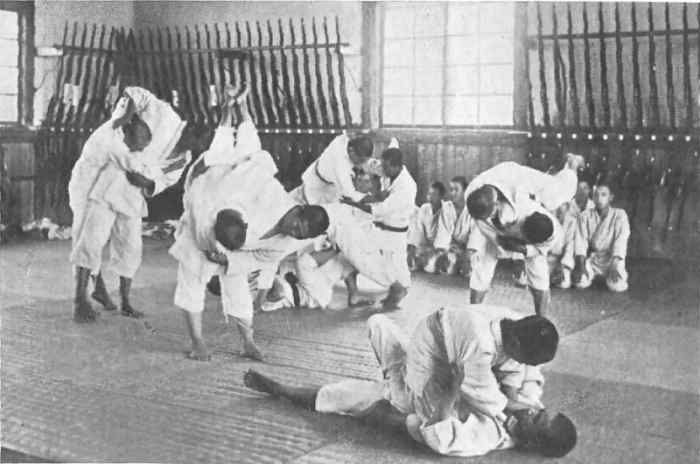
Jujitsu practice, circa 1920.
Judo
Judo is well-known as a sport martial art. It's emphasis is on throws, with some chokes and locks likewise. Information technology's likewise a rather well-rounded art that does, like Jujitsu, include strikes. It's basis is in Jujitsu.
The meaning of that give-and-take Judo is Gentle Way. Founder and proponent, Jigoro Kano, wanted his system not merely to emphasize a gentle fine art but likewise a gentle mode of life.
Kano was bullied in school so sought out Jujitsu education. This was in the mid to late 1800s, when Jujitsu had greatly gone out of fashion in Nippon, as times were irresolute then. Later on much search, Kano was referred to a teacher of Tenjin Shin-yo ryu Jujitsu in 1877. His teacher, Fukuda Hachinosuke emphasized application of the fine art over formal exercises and this is why Kano emphasized sparring and hands-on training in his form of Judo.
After Hachinosuke passed away, Kano continued to train in the fine art of his teacher under the instruction of Iso Masatomo. When Masatomo passed away, Kano went on to study another art called Kito-ryu.
Information technology was in 1882 that Kano founded the Kodokan, or Identify for Expounding the Way, at which he taught Judo.
The emphasis in Judo, like Jujitsu, is in the use of minimum effort for maximum results. This, of course, is that soft principle of "going with" the opponent's force to thrown him, lock him, choke him, etc.
Jujitsu, Judo and Aikido:
- Emphasize minimum effort for maximum results
- Uses opponent's energy confronting him
- Makes employ of joint locks, chokes and throws
Aikido
The techniques of Aikido are basically Jujitsu techniques with particular emphasis on using practically no force at all, and making heavy use of angles and circular footwork to evade and redirect opponents' attacks. Aikido has a strong spiritual component, as emphasized past founder Morihei Ueshiba, every bit the meaning of the word Aikido is Mode of Unifying with Life Energy.
Gyre to Continue
Like Jujitsu and Judo, Aikido emphasizes using the least amount of energy possible for the greatest results possible. In uncomplicated terms, y'all use the opponent'south free energy against him.
Martial Arts that Use Jujitsu
| Judo | Aikido | Defendu | Kenpo | Krav Maga | Eskrido |
|---|---|---|---|---|---|
| Emphasis on using opponent's force against him to throw him, choke him or lock him upwardly | Uses redirection and fluid motion to throw opponent, using minimum effort | Fighting organisation of British Commandos during WW2, emphasized practical awarding of Jujitsu articulation locks and throws. | Early in its inception, Kenpo involved the trading of information and has Jujitsu in its system | Another system of practical self-defense, used in special forces, makes use of very applied awarding of Jujitsu technique | Developed by Cacoy Canete, Grandmaster of Doce Pares Eskrima, involves throws, locks and chokes with the stick |
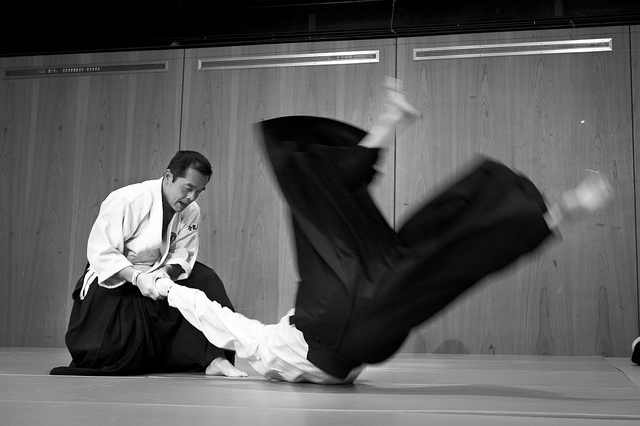
Aikido throw.
HoangP or miniprince, Flickr. Some rights reserved.
Sambo
Sambo is a Russian martial art which combines elements of Greco-Roman Wrestling, Freestyle Wrestling, Asian striking arts, Judo and Jujitsu. Its creators, Vasili Oschepkov and Victor Spiridonov, had been deputed in the 1920s to create a fighting system for the Soviet Red Regular army. Oschepkov had trained with Kano, founder of Judo as previously discussed, and Spiridonov had preparation in wrestling, including native styles of Eastern Europe. Spiridonov too investigated fighting arts of Mongolia and China to include in the new fighting system of the Soviet military. Somewhen this system was taught to and used by the police force, the secret police and special forces of the Soviet Union. Over the years, the system has been modified and added to by its many proponents and practitioners. Information technology involves strikes, chokes, throws and joint locks, including leg locks. It is a well-rounded organization of fighting, involving both grappling and hit.
Defendu
William Eastward Fairbairn worked for the British constabulary in Shanghai and taught the constabulary how to handle a rough oversupply. He had trained in Judo in Tokyo and also had knowledge of various Asian and Western fighting arts. He put together a organisation called Defendu, making apply of the simplest technique of the fighting systems he knew. The techniques emphasize controlling opponents with joint locks, throwing them to the footing to finish them rapidly, and striking where the most damage and debilitation tin be washed. It'southward downward and dirty fighting and this is why Fairbairn ended up teaching special forces during World State of war Two, including the British Commandos and the American Colonel Rex Applegate from the Office of Strategic Services. Applegate went on to train American special forces and secret police.
Rex Applegate Book on his Military Fighting Arrangement
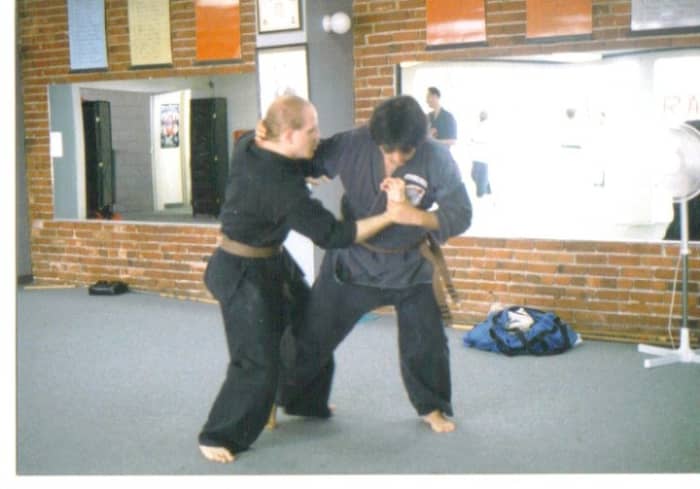
Kenpo makes utilise of locks and throws.
Nathan Bernardo
Kenpo Karate
Kenpo Karate was brought to Hawaii by the Mitose family and James Mitose taught William K. S. Chow and from there information technology was passed on to various practitioners. Hawaii was a cornucopia of martial arts and was home to Filipino arts, grappling arts and Karate arts. Famed Jujitsu practitioner Henry Okasaki taught in Hawaii and an exchange of data between Kenpo and Jujitsu schools was common. There was a time when Kenpo was actually called Kenpo Jujitsu and there was likewise a time when it was heavily laden with Jujitsu techniques. Ed Parker in particular changed the art significantly, adding elements of Eskrima and Kung Fu. Nonetheless, the Jujitsu is nonetheless in there and known to those who exercise the art seriously. Much of it is constitute in techniques confronting Jujitsu techniques. Some of it is non in the techniques but taught to students withal.
Kenpo definitely makes use of redirection, round move and using the opponent's energy confronting him, cornerstones of Jujitsu. It also makes employ of throws, locks and chokes.
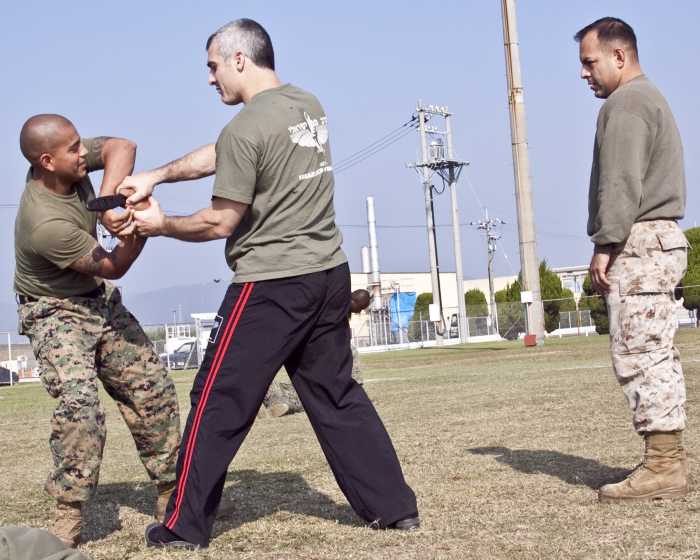
Krav Maga joint lock and disarm.
Krav Maga
Krav Maga was created by street fighter Imi Lichtenfeld, a Hungarian Jew who wanted his people to be able to defend themselves against Nazi brutality around the fourth dimension of their unfortunate reign. He had cognition of various Asian and Western martial arts, including Judo and Jujitsu, which he included in his fine art called Krav Maga. He went on to train Israeli special forces.
Krav Maga is quick and deadly; like many arts that emphasize the necessity to terminate the fight quickly, similar Defendu, it emphasizes hitting vital targets, controlling the opponent and ending the confrontation by any means. Information technology uses Jujitsu where applied and easy. Like Defendu, it's a stripped downwardly system that keeps it unproblematic and brutal. It should be stated hither too, that these special forces systems emphasize close-quarters combat, where real fighting takes place and this is ane of the reasons that Jujitsu is used. Jujitsu is all virtually close-range fighting, in tight and grappling, making use of heavy command of the opponent. The closer you are to the opponent, the more than the need for control, because he is in range to hit you. Also, like Defendu, being down and dirty and practical, it has to involve disarms, which means controlling and manipulating the opponent; essentially, joint locks are important when it comes to controlling a weapon and disarming the assaulter. Jujitsu, of grade, is all nigh the joint lock.
Eskrido
Eskrido is a system created by Grandmaster of Doce Pares Eskrima Cacoy Canete, which makes use of Eskrima stick for locks, throws and chokes. Emphasis is placed on not fighting the opponent's energy, but going with it to put him in a compromising position for a lock, throw, disarm or choke. Sparring involves feeling free energy, not resisting information technology, and going where the opponent goes to apply technique that disables him. I've personally trained in this art and can verify that resisting the opponent'southward energy is counter-productive and going along with information technology to position for locks and throws is much more constructive.
Cacoy has heavy training in Eskrima, Karate and Jujitsu and Judo. He'south adult a well-rounded art that involves strikes, boxing and grappling.
Cacoy Canete Using Eskrido
As yous can see, Jujitsu has been borrowed past many martial arts because of its emphasis on control of the attacker and close quarters combat, in tight where existent fighting occurs. It has definite practical applications that has been recognized for many years and continues to exist a part of practical fighting arts.
© 2014 Nathan Bernardo
Source: https://discover.hubpages.com/sports/Which-Martial-Arts-Were-Created-From-Principles-of-Jujitsu
0 Response to "Which of These Martial Arts Was Created From the Principles of Jujitsu"
Post a Comment