Co Career Explorations Culinary Arts Johnson and Wales
Johnson & Wales commits to build on a legacy and cultivate a more diverse, equitable and inclusive university community.
PROVIDENCE AND CHARLOTTE, like many other historic American cities, have their foundations rooted in a complicated history. Providence was simultaneously a proving ground for religious freedom in early on America and ane of the wealthiest cities in colonial America because of its position as a primal trading post in the global slave merchandise. Charlotte meanwhile congenital its proper name on the antebellum cotton fiber nail.
However, in the centuries since, both cities have become sites of ambition, justice and progress. They are again at a crossroads, staring at the duality of rapid and exciting economic changes while reflecting on what information technology will take to create equitable opportunity for all.
Johnson & Wales University has played a role in supporting that mission every bit a forward-thinking institution since its 1914 founding past Gertrude Johnson and Mary T. Wales, years earlier women had secured the right to vote. The university has recently redoubled its commitment to opportunity and understanding with the launch of its Diversity, Equity and Inclusion (DEI) initiative aimed at students, staff and faculty.
Subsequently more than a year of collaboration across stakeholders and campuses, the try signals the next chapter in pursuit of a academy that is truly diverse, equitable and inclusive.
The need for such a campaign came into focus in the wake of last twelvemonth's murder of George Floyd by former Minneapolis police officeholder Derek Chauvin. The protests and anger that followed swept the nation and sparked a conversation at higher education institutions, including JWU, which propelled colleges and universities to more directly face up questions about racial justice.
"Suddenly, that chat was at the forefront on our campus," says Providence Campus President Marie Bernardo-Sousa, LP.D., '92. "We wanted to ensure that whoever engaged in that chat, whether it was our faculty, staff or students, felt they had the advisable toolkit to support and challenge ane another."
The kickoff pace was to convene listening sessions and public forums to understand the issues and sentiments across the university. A number of students of color stepped forward to say they felt alienated and unsupported, a difficult truth that senior leaders took seriously.
In one listening session, a Black educatee asked: "When you lot see someone who looks like me walking down the street, do you see a criminal or a person?" Information technology'due south a question that cuts to the core of matters of privilege and implicit bias that many institutions are against.
"I think everybody was taken ashamed by the question," Bernardo-Sousa recalls. "The conversation that ensued was uncomfortable, at times heartbreaking and at other times uplifting. Information technology was a brave and safe infinite where students had courage and trust in the procedure to permit united states to have a conversation to unpack. Information technology was incredibly meaningful."
A call went out to faculty and staff in Providence: The university was forming a committee called the Inclusion, Diversity, & Disinterestedness Activity Grouping (IDEA), seeking staff and faculty volunteers.
"What I like virtually IDEA is that you lot tin can work in whatever section and withal have a function to play in this work," says Michael Waugh, managing director of the Bridge for Diversity, Equity and Social Justice. "Information technology's nigh setting a civilisation and an expectation and spreading work across all units of the university."
Once they identified the most pressing issues, the Thought Group separate into working groups, including mentoring, programming, and employee recruitment, training and retention. Korina Ramsland Short, director of the JWU Gender Equity Center, volunteered to head the mentoring program, which matches students with peers and counselors who share their identity to help guide them through the academy experience. "A peer-to-peer program would support students and ensure a sense of belonging," she says. "They would accept somebody who's been there and tin can understand them."
The IDEA grouping as well made inroads with community partners in Providence. JWU students are now piloting mentorship programs with the Rhode Island Black Business Clan, Rhode Island Coalition for Blackness Women, and the Young Womxn's Disinterestedness Coalition. The group has also facilitated several professional development seminars for both kinesthesia and staff with Lorenzo Boyd, Ph.D., the quondam vice president for Diversity & Inclusion at the University of New Haven and a nationally-recognized leader in police force-community relations and DEI in higher instruction.
"In order for true learning to happen, universities have to make rubber spaces for all employees, not just students," says Boyd. "I appreciated Johnson & Wales' approach because most universities come to me later a major incident whereas JWU wanted to get ahead of the curve. Also, its upper administration led by instance. Ordinarily these webinars are geared toward rank-and-file, but senior leadership — including both campus presidents — participated in the sessions."
One concern that students and faculty shared in listening sessions was that of employment. Students credit Johnson & Wales' admissions and enrollment team for their successful efforts to recruit minority students, with almost half of the Providence pupil population and three-quarters of Charlotte's being non-white. Students claimed, however, that faculty and staff on campus did not mirror the aforementioned level of multifariousness.
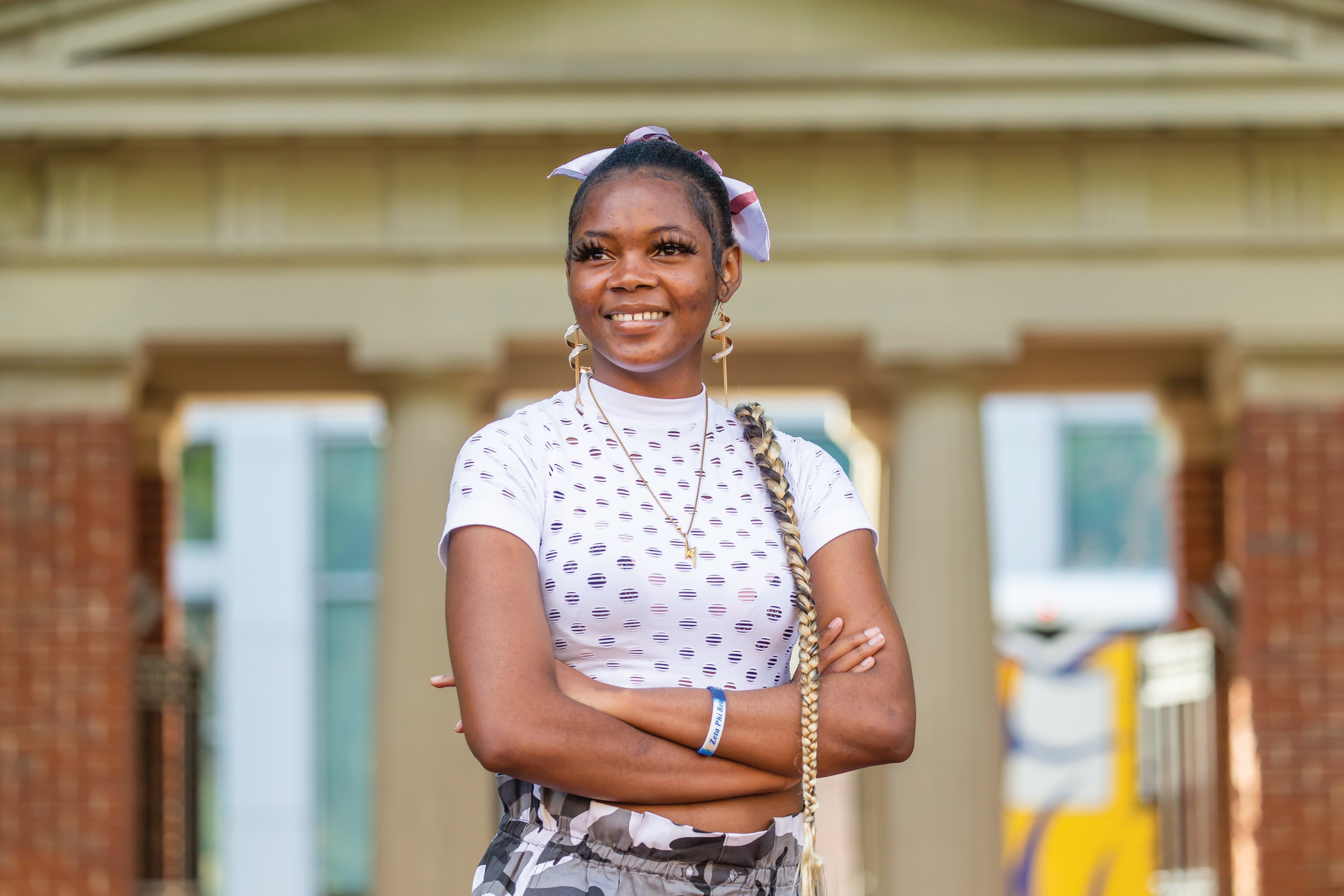
Pheedy Umar '23, the president of the Blackness Pupil Association, points to on-campus counseling as one area for improvement. Despite beingness such a useful and pop resource, she says there is not enough diverseness amidst counselors to meet pupil torso demands. "I know a lot of Black students who will not go to counseling for that reason."
Assistants leaders recognize the need to recruit more than diverse talent, besides. The academy has taken meaningful steps to emphasize the importance of diverseness, equity and inclusion in management training programs. Information technology has worked with hiring managers to identify creative ways to aggrandize outreach during the recruitment process that will help attract more diverse talent for faculty and staff positions.
The Idea Group is establishing a network of affinity groups for employees who share a social identity. It has also been doing outreach to various universities and organizations to build relationships and opportunities for recruiting various kinesthesia and staff. This summertime, a pilot job fair was organized to recruit adjunct faculty of color for the College of Business, with a target of filling two full-time faculty positions.
According to Educatee Authorities Clan (SGA) Senate Speaker Sarah Bouffard '22 increasing the number of faculty and staff members of color will "modify the dialogue that's happening in the classrooms and change the dialogue that students are using when they go out those classrooms."
Source: https://www.jwu.edu/news/stories/magazine/2021/winter/looking-inward/index.html
0 Response to "Co Career Explorations Culinary Arts Johnson and Wales"
Post a Comment